
A Free Guide to the Common App: The AXS Companion

By info@dolphinparents.com · October 21, 2026

Who it’s for: Students in grades 11–12 applying through the Common App, plus their parents and counselors.

When to use it: August through January of senior year. The Common App opens August 1, early deadlines fall in November, and most regular deadlines land in early January. Juniors can preview the videos in May–July to get a head start.

The Common App is how most students apply to college, and it has a lot of parts. Test scores, activities, courses and grades, essays, a list of colleges. If you’ve never filled one out, it’s hard to know where to start.

Many students don’t get much one-on-one help with it, either. School counselors often have hundreds of students each. First-generation students feel this the most, because there’s no one at home who has done it before.

That’s why we want to point you to the AXS Companion. It’s a free online guide that walks students through the Common App, one section at a time.

What the AXS Companion is

The AXS Companion was built by volunteer counselors from the Independent Educational Consultants Association (IECA), working with Oregon State University Ecampus. It launched in 2022 at the national NACAC conference, held that year here in Houston. It’s supported by The AXS Foundation, a nonprofit that keeps it up to date as the Common App changes.

It includes more than 70 narrated videos, plus guides from college admissions experts. Topics include:

  • An overview of college admissions
  • Submitting test scores
  • Filling out the activities list
  • Writing the personal essay
  • Entering courses and grades
  • Using the My Colleges section
  • Financial aid, with videos in English and Spanish

A few things we like about it:

  • It’s free. No cost, no trial, no upsell.
  • No sign-in. Students don’t create an account, and the site doesn’t track them.
  • It’s trusted. NACAC, the national association for college admission counseling, lists it as a trusted source.

How to use this Common App guide

There are two ways to use the AXS Companion.

Go start to finish. Open the Common App in one window and the AXS Companion in another. Watch each video, then fill in that section. This works well for seniors starting their application this fall.

Drop in when you’re stuck. Only need help with the activities list or the essay? Go straight to that module. Each one stands on its own.

Parents, watch with your student. You don’t need to know the Common App to help. Watching a video together gives you the same starting point, so you can talk about it at the kitchen table. The financial aid videos are especially worth watching together.

Counselors and advisors: the same team runs the AXS Toolbox, a free set of lesson plans, slides, and student worksheets built around the AXS Companion. It’s useful for group sessions and workshops.

Put it in your plan

The AXS Companion shows you how to fill out each part of the Common App. A plan helps you actually get each part done, on time.

If you use DolphinParents, here’s a simple way to combine the two:

  1. Add a task for each Common App section: activities, essay, courses and grades, and so on.
  2. Paste the matching AXS Companion link into the task’s notes.
  3. Give each task a due date that works back from your application deadlines.

Or skip the typing: AskDolphins.ai in one sentence, and it creates the task with the due date and link for you.
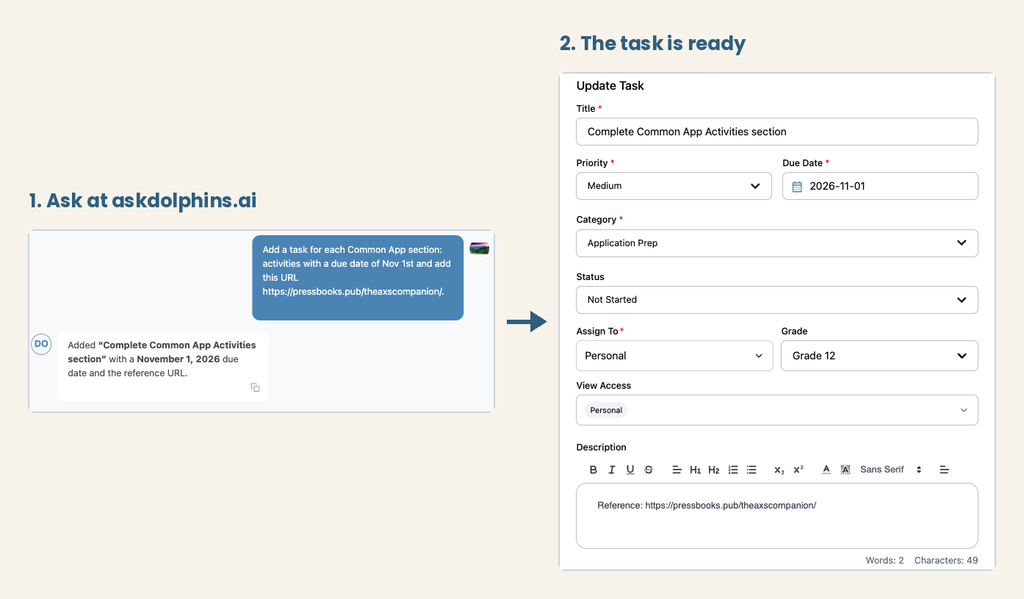
Now your student knows what to do next and where to get help with it, and parents and counselors can see progress along the way.

Not on DolphinParents yet? It’s free (Basic package) for families. Sign up at dolphinparents.com.

We aren’t affiliated with The AXS Foundation. We just think it’s one of the best free resources out there.

Links

Your School Counselor Has 372 Students. Your Kid Needs an Advisor

372 to 1

That’s the national average student-to-school-counselor ratio. The recommended number is 250 to 1 — and most states have never hit it.

But the ratio isn’t even the real problem. Your school counselor’s day is mental health crises, attendance, scheduling, and discipline. College advising is one line on a job description that has absorbed a dozen other roles. So when your family walks out of a fifteen-minute spring meeting with a printed list of six schools, nothing went wrong. The system was just never built to do what you assumed it would.

Which means the real question isn’t whether your student needs more help. It’s how to choose it well.

One note on words: we say advisor, not counselor. A counselor supports mental health and wellness — important, and a different job. What your student needs is strategy: course plans, a focused activity list, honest odds, real deadlines. That’s advisory work.

The 5 questions that matter

A great private advisor can be worth every dollar — experience, perspective, and time you may not have. Packages are a real commitment, though ($140–$300 an hour, $4,000–$12,000 for the full ride), so the goal is finding the advisor whose approach fits your family. These five questions get you there fast:

  1. What exactly is included — in writing? “Comprehensive support” means different things to different people. Ask for deliverables: how many meetings, what’s covered, how fast essays come back. Clear scope protects both sides.
  2. How do you keep me in the loop without taking over? Hardly anyone asks this, and it predicts satisfaction better than any credential. The best advisors welcome it — and have a real answer ready.
  3. What does my student walk away with that’s tangible? Advice fades; artifacts don’t. A course plan, a portfolio, a completed project, a verified credential — those stay. Admissions offices in 2026 want evidence of capability, not statements of interest, and a strong advisor helps your student build exactly that.
  4. How many students are you taking this cycle? Part of what you’re paying for is individual attention. School counselors are stretched across enormous caseloads — often 372 students to one. A smaller load is a big reason to go private, so it’s worth confirming what you’re actually getting.
  5. Can we start small? Many excellent advisors will offer a low-cost first session so you can both confirm the fit before committing to thousands. It’s a sign of confidence and a smart way to begin any working relationship.

Homeschooling? Add a sixth: what proof will my student have from outside the house? Colleges accept parent-made transcripts — but they look for external validation. Dual enrollment, AP scores, portfolio work, a verified third-party credential. That’s what makes a homeschool application land.

See how one advisor answers these

Chandan Gokhale runs Gigaplex Academy, where students in grades 8–12 complete real AI internships — building working solutions for actual businesses. Students finish with a verified internship certificate and a project portfolio an admissions reader can actually look at. He offers a free 60-minute orientation with no commitment.

See his profile and availability: https://dolphinparents.com/marketplace/profile/?id=206&role=tutor

Or browse all advisors by specialty, with transparent rates and direct booking: https://dolphinparents.com/marketplace/

The families whose seniors are calm in November aren’t luckier than you. Someone was just paying attention. Start with one conversation.

—

Are you an advisor? Get listed where families are searching. Flat monthly pricing, no revenue share — you keep 100% of your rate: https://app.dolphinparents.com/signup

Links
https://dolphinparents.com/marketplace/

https://app.dolphinparents.com/signup